Recently, I’ve had this love for this tabletop game called Warhammer 40,000. It’s made by this company called Games Workshop. Which is kind of a silly name for a company in my opinion (though I heard a rumor somewhere that the company actually began in a workshop), but I guess it’s somewhat sentimental, or maybe workshop is just a British term:
The company used to have this really ugly logo that reminds me of Windows hot dog stand. But they seemed to have changed it to something much more aesthetically pleasing, even if it had a little bit less identity.
But going back to the flagship product of the company, It’s a Miniatures Wargame set within the 41st millennium. Best described by its tagline:
In the grim darkness of the far future there is only war.
This setting of this game is… quite bleak. And that’s honestly an understatement. It’s more:
“The entire world universe is messed up and has been permanently ravaged by thousands of wars with no foreseeable conclusion nor resolution”
It’s probably the reason why “Grimdark” has become a term used to describe speculative fiction that has a similar setting of hopeless and bleak. It’s kinda like DOOM in some ways, though more serious. But “At Doom’s Gate” would suit the series quite well.
In the real world, these guys would eventually get tired of fighting all the time and probably just figure out how to come to some kind of conflict resolution. But when you have cultishly devoted superhumans fighting “for the emperor” (who currently seems to be on life-support for the past 10,000 years), I don’t think that you are going to have any form of political agreement.
The Warhammer 40K universe is a shared one written by all kinds of authors over the years. And spans across books, a handful of movies, video games, an official magazine by the company covering its products, and an upcoming live action TV series slated for Prime Video. And with over 38 years of content, it would be virtually impossible to keep up with it all.
I actually don’t really know too much about the Warhammer 40,000 universe beyond the official codex for my army and the product blurbs on the websites. And personally, it doesn’t matter too much to me. Even the folks at Games Workshop have made comments implying not to take it all too seriously, as “Everything Is Canon, Not Everything is True“. Which is great because I think that kind of mindset helps foster a culture around being creative and not worrying too much about following the rules.
What I like are the figurines. They look really nice, and it’s quite enjoyable to paint them and to see them all together. Though in my personal opinion, I like assembling a lot better compared to the latter. But I also hail from working with various LEGO sets as well, so following directions isn’t exactly something that comes as a challenge for me.
The Game
In a lot of ways, the tabletop game feels like a trading card game. Mainly in that you build a team using various resources of a specific kind. And then a solid amount of the challenge of the itself is adapting to what your opponent brings to the table.
There are many other different collections of miniatures to choose from of various factions. But with all of them, you have to put them together and paint them. There is no preassembled, prepainted options made by the company for the purchase. This is annoying if all you truly want to , but its also part of the game as well since the choices you make while assembling determine what weapons your characters have,
For my army, I chose the Space Marines, a group of genetically modified superhuman monks who wear a fierce, striking set of power armor. They just seem like the definitions of cool with their glowing red eyes, and fantasy + sci-fi armor.
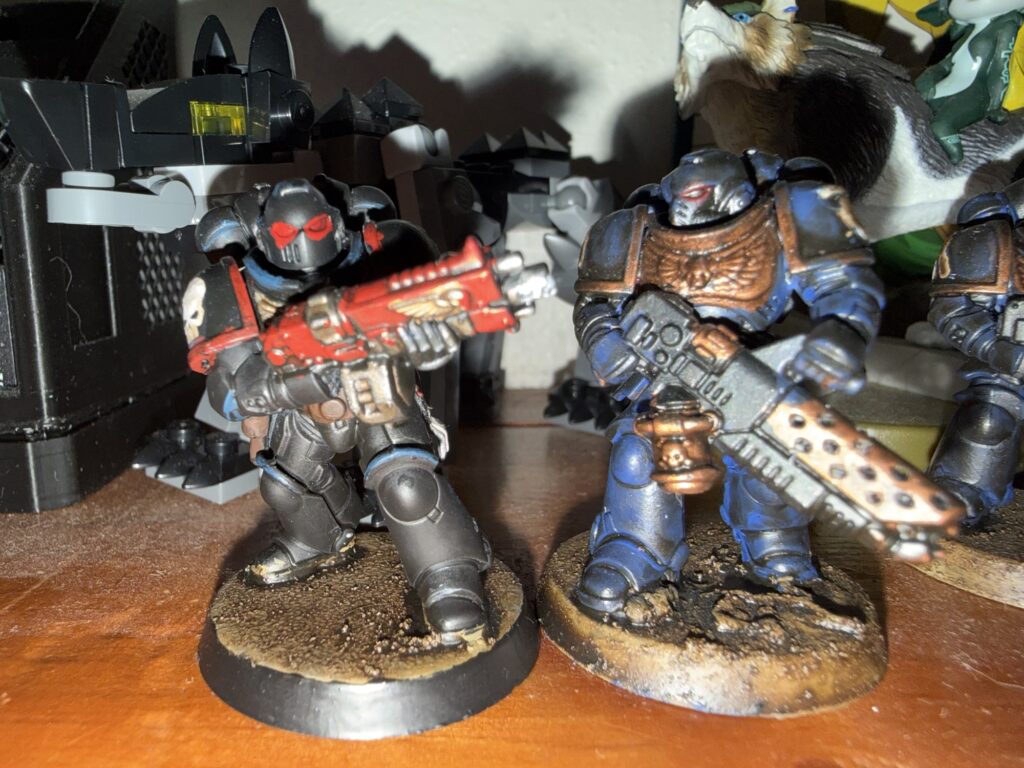
The specific chapter of the Space Marines that I chose, the Black Templars, are a legion of vicious, vengeful nomads who wander the cosmos in search of Xenos and heretics (a common recurring crime meant to help sustain the existence of the emperor I was talking about earlier, I think). I chose them because of a funny video I saw (NSFW Warning) that I saw way before I knew what Warhammer was, as well as the fact that they matched my fursona’s color scheme.
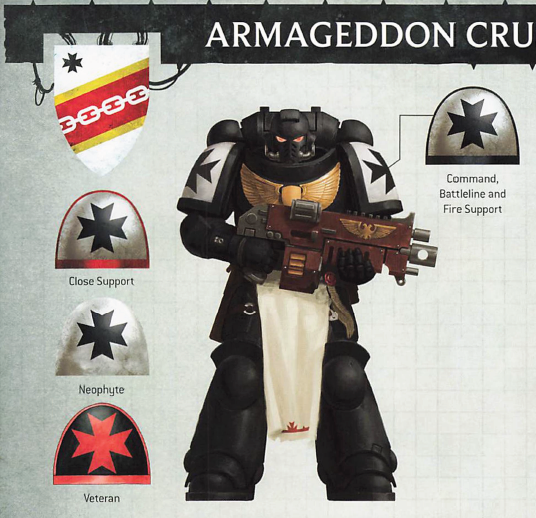
Assembly and Painting
Although the models themselves look quite complex and detailed, there isn’t really much you have to do to put them together besides be able to follow the instructions in the manual. And like I said, “Everything is Canon”, so there isn’t too much to worry about if you make a mistake and break something, or paint in a way that doesn’t quite match up with the box. Creativity is encouraged, and mistakes can make room for opportunities.
That said, I did have a lot of trouble putting together my Land Raider Crusader (a tank used for transit by the Marines, shown above) because of few of the pieces having actual numbers on them (the assumption likely being that each piece looked unique enough that they weren’t needed). In addition, the copyright date for the kit itself was 1999, 3 years before I was even born! Based on some research that I did, it’s likely that during manufacturing, the sprue used to construct the pieces had been used so many times, that the plastic itself was slightly warped as a result. And subsequently, the pieces of my tank don’t sit flush with everything else.
But we’re not done once we put everything together. We still have to paint it as well. For the Space Marines especially, this is important since many of the chapters are just palette swaps of each other, with a few chapter specific models to tie them together (in addition to any chapter specific pieces you choose to use that you saved from the kits of other models).
Painting the figures takes a bit more work compared to assembly. But it still isn’t super difficult either.
Games Workshop makes their own lineup of paints under its Citadel brand (the same brand used for the miniatures), and one of the nicest parts is that you really don’t need to have a good slate of hand to paint. Because once you finish coloring and everything, you get to apply the washes, which are referred to as shades. And those will do a good job at covering up any mistakes, in addition to making your models look nicer.
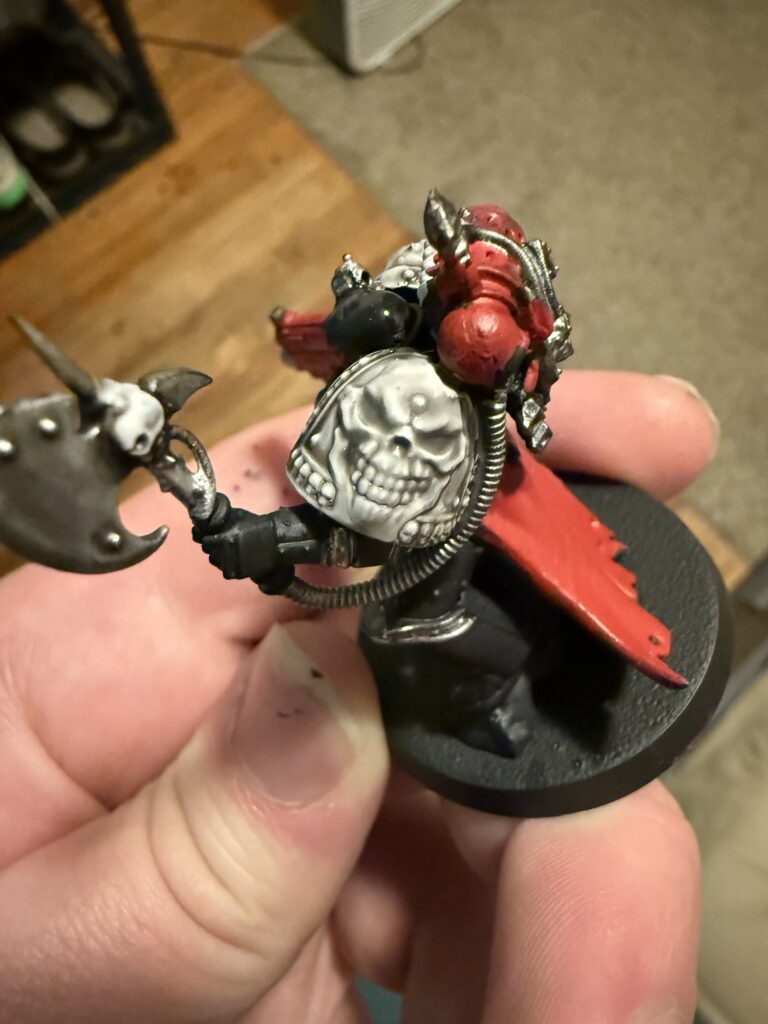
In addition to Citadel paints, I’ve also used Rustoleum Spray Paint, and some paints from another brand called The Army Painter. Which were part of another kit that I bought at my Local Game Store. There’s quite a bit of supplies all over the place that I need to look for. And for some of those things, there’s a lot of places to buy it. Which leads me to my next topic.
The Stores
One of the things that surprises me the most about Games Workshop (and why I’m writing several paragraphs about this) is their actual retail presence. Scattered across the United States are a chain of Warhammer stores (Warhammer being the official name of the store since 2017) officially ran by Games Workshop.
It feels quite peculiar to me that a series of franchises as niche as Warhammer could not only have enough merchandise to fill an entire retail store, but also continue getting sustained amounts of business to remain open. And indeed, not everything sold by the company is available at the stores. But there is enough that you could purchase everything that you need to get started with building and painting. And anything that isn’t available can be purchased from the official website and delivered to an official store, free of charge.
Specialties
It’s no Apple Store, with the limited hours and much smaller store space, but much like them, the service at my nearest one, to put it like they do at Apple, is simply phenomenal.
The first time I went there on a Friday afternoon, the store was empty, and there was a single person there. I had walked in looking for some paint that I couldn’t find at my Local Game Store, having spent close to an hour looking on the rack there for the specific one, and being told by the employees that anything in stock would be on the rack when I asked about it, as well as a mouldline remover. When I asked about the paint, the associate immediately pulled it out for me.
There’s also a lot of other attempts to get you in the door compared to your Local Game Store, who mostly try to do so by having lower prices compared to the official stores, that are likely obtained by not having all the marketing I’m about to mention. Whether or not GW passes off these savings to them or they take the losses themselves remains unknown to me.
For starters, there’s a free miniature to take home each month, and a collectable coin they give out as well with qualifying purchases. The staff are also willing to show you how to paint better as well with yet another one (though this one doesn’t seem to change as often), and they are also willing to show you how to play some of the games as well.
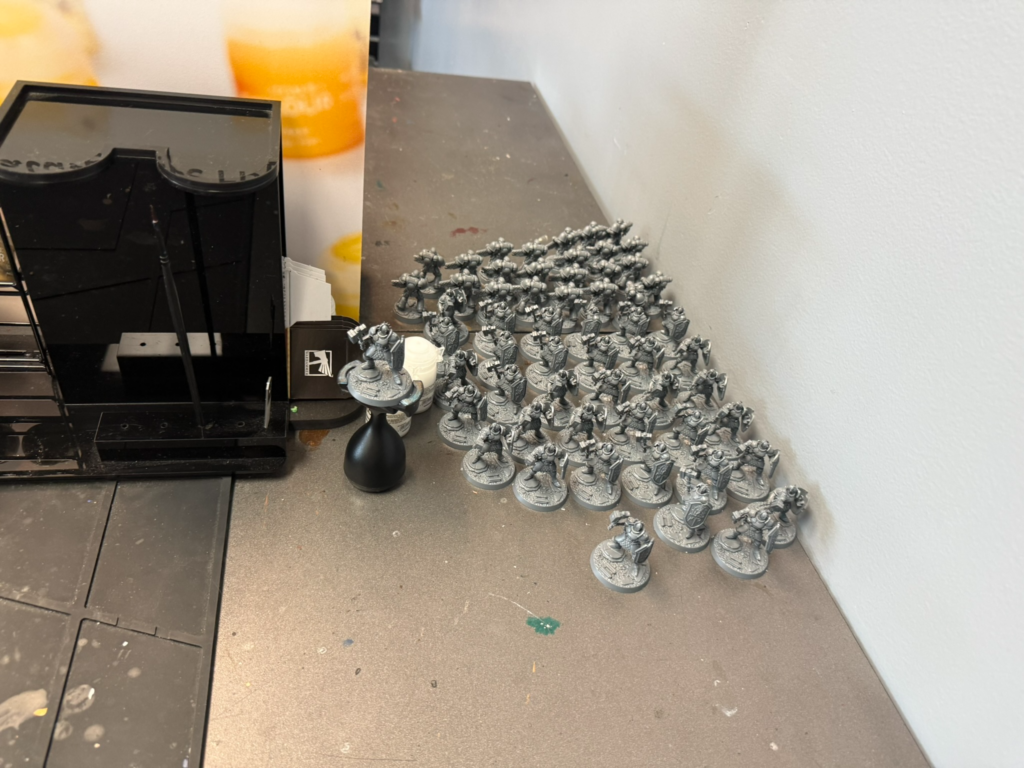
There’s also quite a few drives for engagement with all your purchases in exchange for all sorts of other freebies. One in particular seemed to involve setting a goal for painting figures over the new year. But one of the biggest and most elaborate ones that I’ve seen, is the “Battle Honours” program.
Battle Honours
Designed for new players, and likely younger ones in particular. This 50 page booklet asks you to purchase items and complete various activities to receive various other rewards from the store.
The tasks ask you to engage with a majority of the flagship products the company offers, and assumes that you have done zero research on your end about Warhammer, and would like information about Warhammer spoon-fed to you. It starts with you making a shopping list.
Yes I’m serious:

To summarize the rest of the challenges and their rewards, the list then goes through asking you to put together the sets you buy (a box for holding all the spare parts you don’t use), painting them (a brush wallet), playing some games (4 six sided die), and reading some of the books (a double sided poster of the maps for Age of Sigmar and 40,000). If you complete all of this, your grand prize is a small little carrying case. Which I really have my eyes on because the logistics of carrying all these figures is quite challenging.
Layout
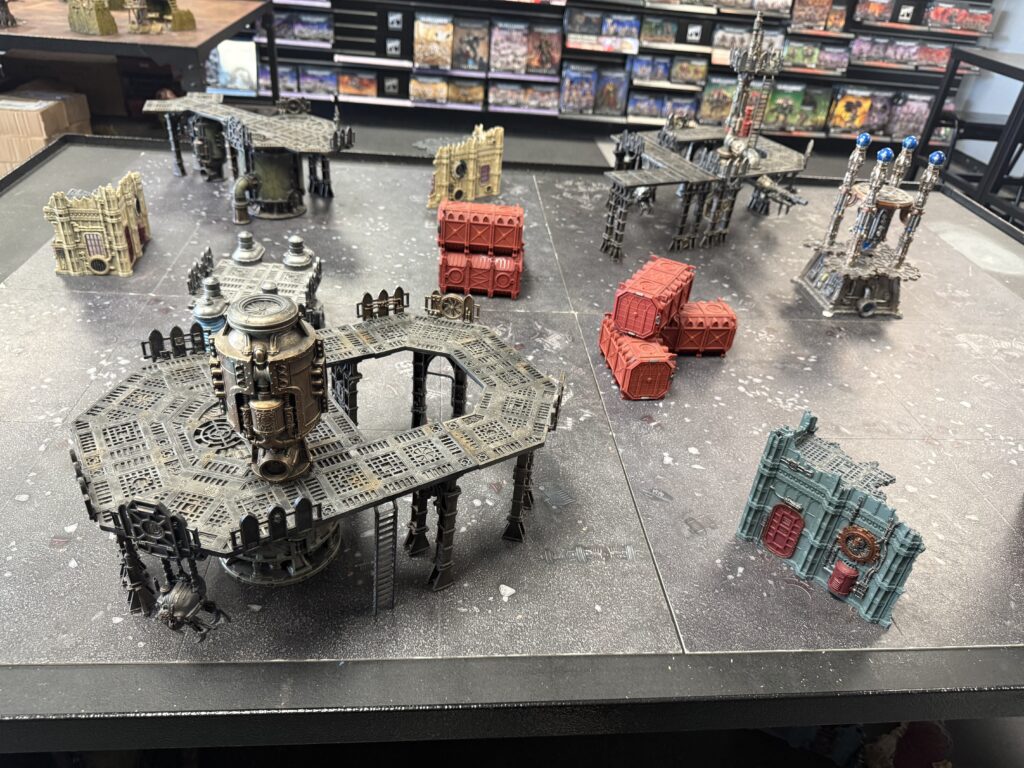
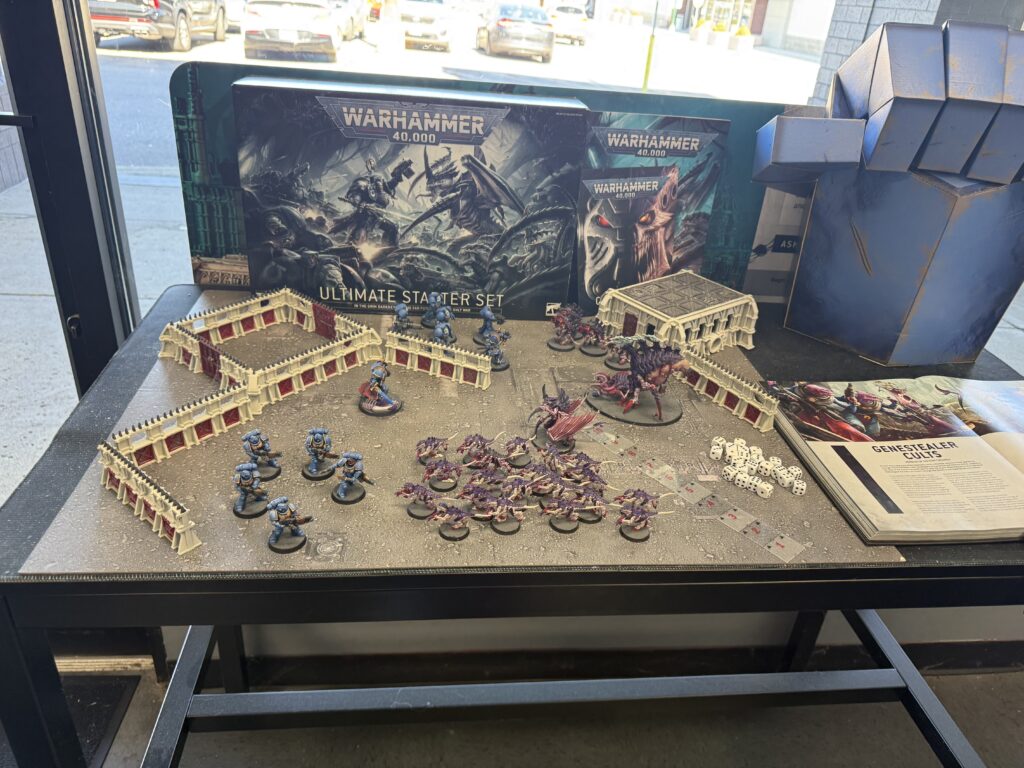
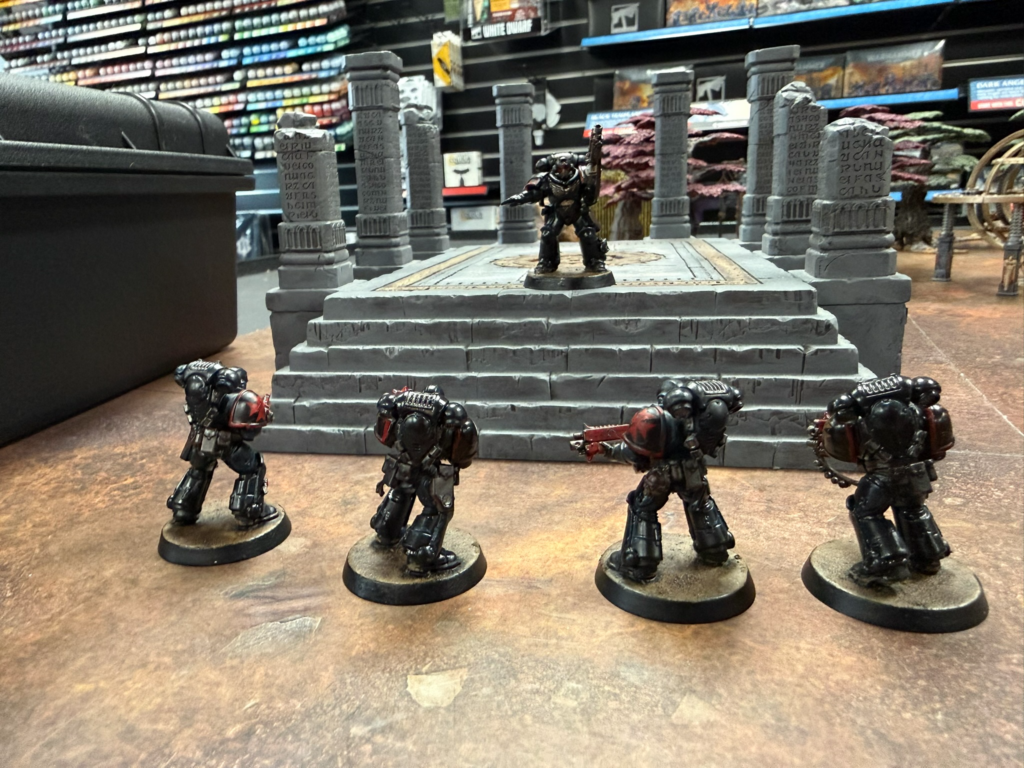
Much like the Apple Store, the general layout of the store felt like it was designed for window shopping. Although the size of the store prevents a full on gallery of every possible item, there’s still enough to give you an idea anyway.
Conclusion
Overall, the past couple of months have been enjoyable. I’ve built a 2000 point army, and now, I’m hoping that I’ll eventually be able to find a group to play with. But even if I never do, I’m pretty sure that it’ll be enjoyable from time to time picking up a set to build. The tech field is pretty rough, so I would say it’s probably important to have things to do that can distract you from it.
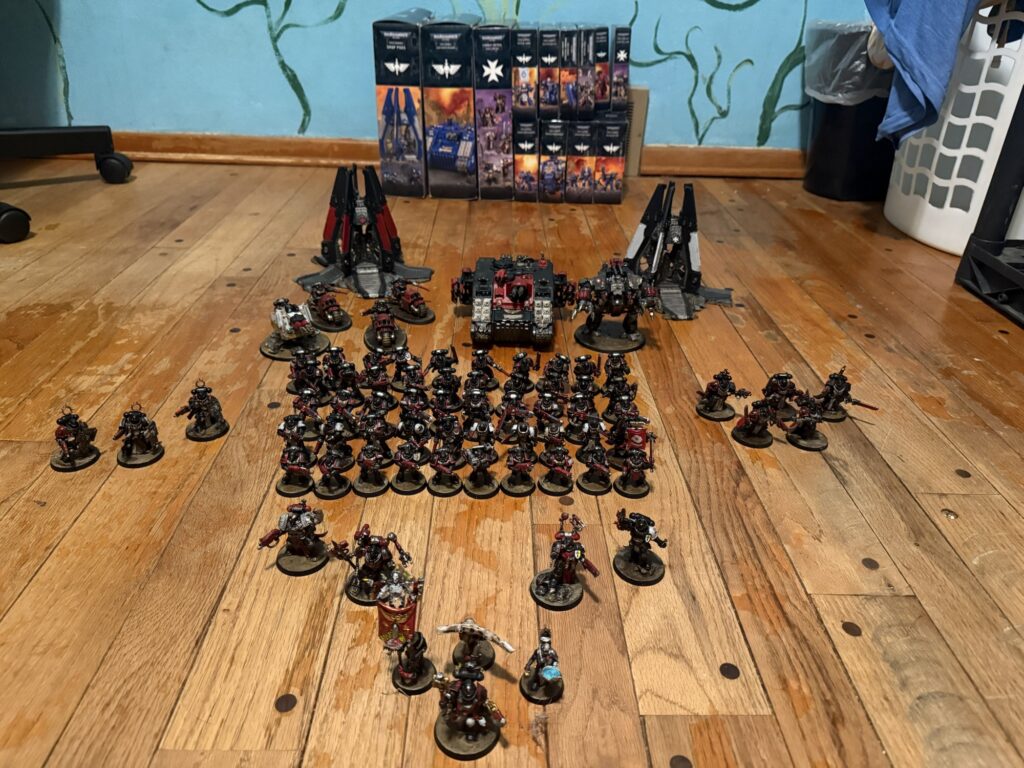
Warhammer definitely isn’t the cheapest thing out there. It’s likely cost me a ballpark estimate of 800+ USD to build what’s I’ve done. But I simply cannot lie that I enjoyed a lot of it.

